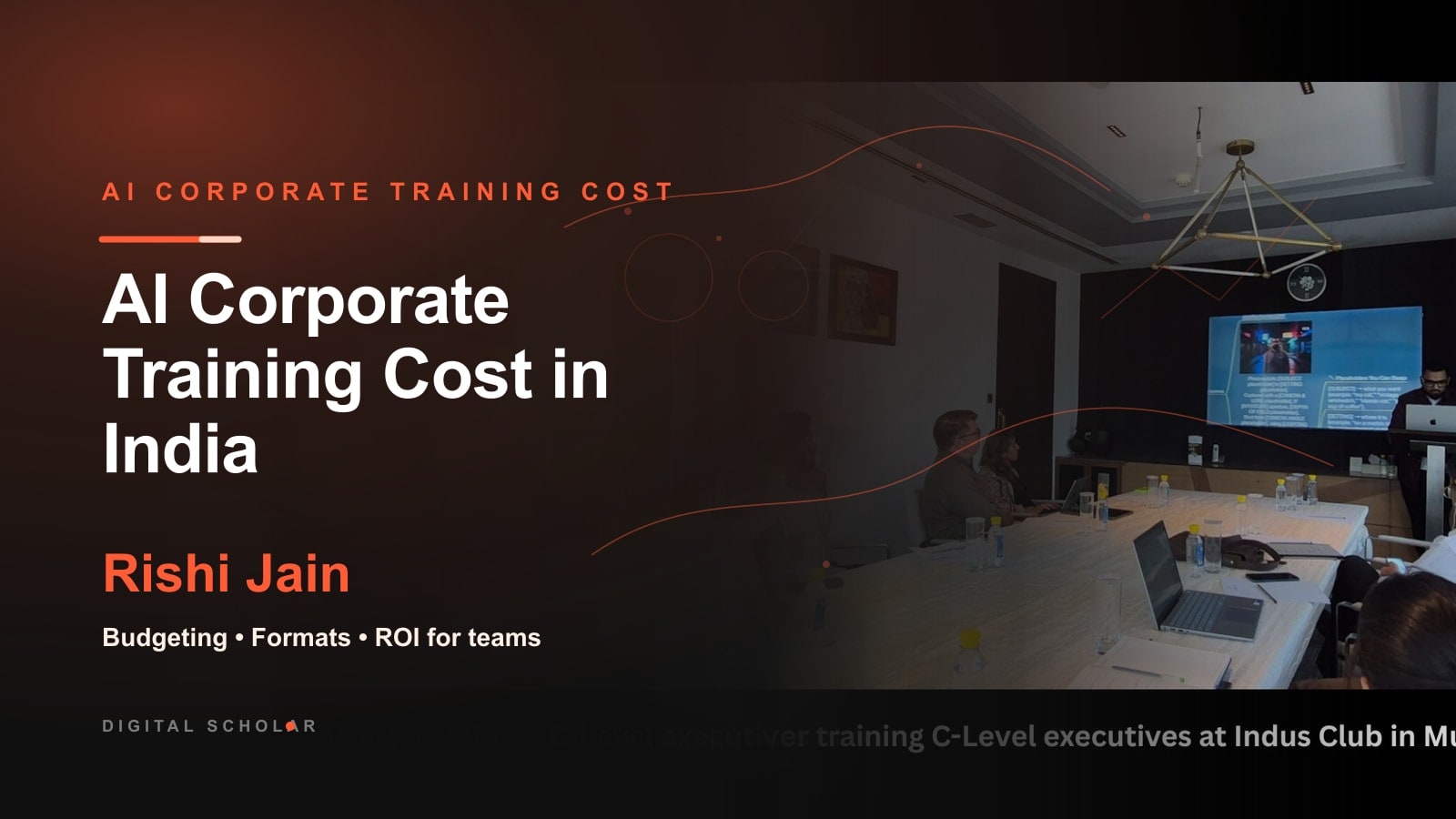
AI corporate training cost in India in 2026 sits in a wider band than most other corporate training categories. The cheapest options are around ₹50,000 for a half-day awareness session with a junior trainer. The most expensive options are ₹50 lakh+ for a Big-4 multi-quarter engagement. The honest middle, where most quality independent trainers operate, is ₹3.5 lakh to ₹18 lakh per engagement.
This article gives you the actual bands, what each band buys you, the hidden costs to ask about, and a decision framework so you do not overpay for the wrong thing or underpay for what you actually need.
The four bands of AI corporate training cost in India
Band 1: ₹50,000 to ₹1.5 lakh. Half-day or full-day awareness sessions delivered by junior trainers, agency intermediaries, or generalist L&D vendors. Useful for entry-level employee awareness if the goal is "everyone has heard of AI". Not useful if the goal is workflow adoption. Most teams do not change behaviour after these sessions.
Band 2: ₹2 lakh to ₹4 lakh. Leadership briefings by senior independent trainers. Designed for CXO and function-head audiences. Outcome is alignment and decisions, not operator training. Common as a prerequisite step before a wider rollout.
Band 3: ₹3.5 lakh to ₹12 lakh. The main band for senior independent corporate trainers. Includes 1-day operator workshops, 2-day bootcamps, and customised industry-specific sessions. This is where most real corporate training happens in India in 2026.
Band 4: ₹12 lakh to ₹18 lakh. Multi-cohort programmes for 100+ employees split across departments. Phased delivery over 4 to 8 weeks. Each function gets its own track with shared frameworks and function-specific use cases.
Band 5: ₹50 lakh and above. Big-4 multi-quarter engagements. Includes advisory, multiple training rollouts, change management, and a designated programme manager. The price reflects the assurance and paper trail value, not the per-hour quality of delivery.
What each band actually buys
Band 1 (₹50,000 to ₹1.5 lakh). A generic deck, a generalist presenter, no customisation, no workflows shipped, no follow-up. Awareness only. Use case: small companies (under 30 employees) where the goal is "let us all hear about this together once".
Band 2 (₹2 lakh to ₹4 lakh). A 3 to 4 hour CXO briefing. The trainer is senior, the content is customised to your industry, the outcome is 3 to 5 specific decisions the leadership team makes by the end. Travel and prep included. Use case: companies of any size where the leadership team needs to align before a wider rollout.
Band 3 (₹3.5 lakh to ₹12 lakh). A 1 or 2-day operator workshop. The trainer is senior, the content is customised, the team leaves with workflows shipped, prompts saved, and a 30-day follow-up plan. Travel and material included. Use case: single function (marketing, sales, HR, or operations) or single department of 15 to 60 people.
Band 4 (₹12 lakh to ₹18 lakh). Multi-cohort programme across functions. Each function gets a day. Shared frameworks, function-specific labs. Includes a leadership briefing, the operator days, and 30 to 60 days of follow-up. Use case: companies of 100 to 1,000+ employees rolling out AI org-wide.
Band 5 (₹50 lakh+). Multi-quarter advisory and rollout managed by a Big-4 firm. Includes change management, programme office, KPI tracking, and multiple training waves. Use case: large enterprises with formal procurement requirements that prefer Big-4 paper trail over per-hour quality.
The hidden costs to ask about
Travel. Most senior trainers include travel within India in the quote, but ask explicitly. Some quote separately. International delivery typically adds travel and accommodation.
Materials. Workbooks, prompt libraries, and post-workshop PDFs should be included. If they are not, the quote is incomplete.
Tool subscriptions. The workshop does not buy ChatGPT Enterprise or Claude Pro for your team. Budget separately. For a 30-person team, AI tool subscriptions land at ₹2 lakh to ₹6 lakh per year depending on plans.
Follow-up. 30-day WhatsApp follow-up is usually included. Beyond that, ongoing advisory is priced separately, typically as a monthly retainer in the ₹50,000 to ₹2 lakh band.
Customisation depth. A senior trainer will not deliver a generic deck. If a quote says "we can customise for ₹X extra", question what the base session includes.
The cost per person framing (and why it can mislead)
Many procurement teams ask for cost per person. The math is straightforward: divide the engagement cost by the number of attendees. A ₹6 lakh workshop for 30 people is ₹20,000 per person. A ₹3.5 lakh workshop for 40 people is ₹8,750 per person. A multi-cohort programme at ₹15 lakh for 200 people is ₹7,500 per person.
But cost per person tells you nothing about value per person. A ₹4,000 per person session with a junior trainer that leaves nothing behind costs more per person who actually changes behaviour than a ₹20,000 per person session that produces real workflow adoption. The right denominator is "cost per person who is using AI weekly 30 days later", not "cost per person who attended".
ROI ranges we have measured
The honest answer on ROI: it depends on the function, the team, and the discipline of the rollout. The ranges below are from 2025 and 2026 engagements where we measured 30 and 60 days post-workshop.
- Marketing teams: 11 to 14 hours per person per week saved at 60 days
- Sales teams: 2.3x to 4.1x first-touch reply rate, 23-minute average summary turnaround vs same-day previously
- Customer service teams: 60 to 75% reduction in first-reply drafting time
- HR teams: 23 to 35% reduction in new-joiner ramp time, 60% faster JD turnaround
- Finance and operations: 4 to 6 hours per week saved on MIS commentary and variance writing
If you do the math on these against the team's loaded cost, even a Band 3 engagement (₹3.5 lakh to ₹12 lakh) pays itself back in the first quarter for most teams of 25+ people.
What to spend on if budget is tight
If you have ₹3 lakh and want maximum impact: a 1-day operator workshop for your highest-leverage single function (usually customer service, marketing, or sales). Pick one function, train them well, measure at 30 days, then use the receipts to budget the next round.
If you have ₹6 lakh: a leadership briefing for the CXO team, plus a 1-day workshop for one function. Leadership alignment plus a working operator pilot in the same quarter.
If you have ₹15 lakh: a leadership briefing, a 2-day bootcamp for two functions, and 60 days of follow-up. Most balanced spend for a mid-sized Indian company.
If you have ₹50 lakh+: either a Big-4 engagement, or 3 to 4 independent senior-trainer engagements across the year focused on different functions. The second option usually delivers more behaviour change per rupee, but the first option carries more procurement comfort.
Honest admission
Pricing in this market is not transparent. Some trainers quote based on perceived budget rather than scope. Two companies asking for the same workshop can get quotes that differ by 2x. The way to protect against this is to write your scope precisely (number of attendees, format, duration, deliverables, follow-up) and ask for itemised quotes. A senior trainer who refuses to itemise is not the one to work with.
Booking
For a custom proposal, use the corporate training enquiry form. The team responds within 48 hours weekdays with available dates and an itemised quote. For format details, see AI corporate training programmes. For the comparative ranking against other trainers, see Best AI corporate trainers in India 2026.