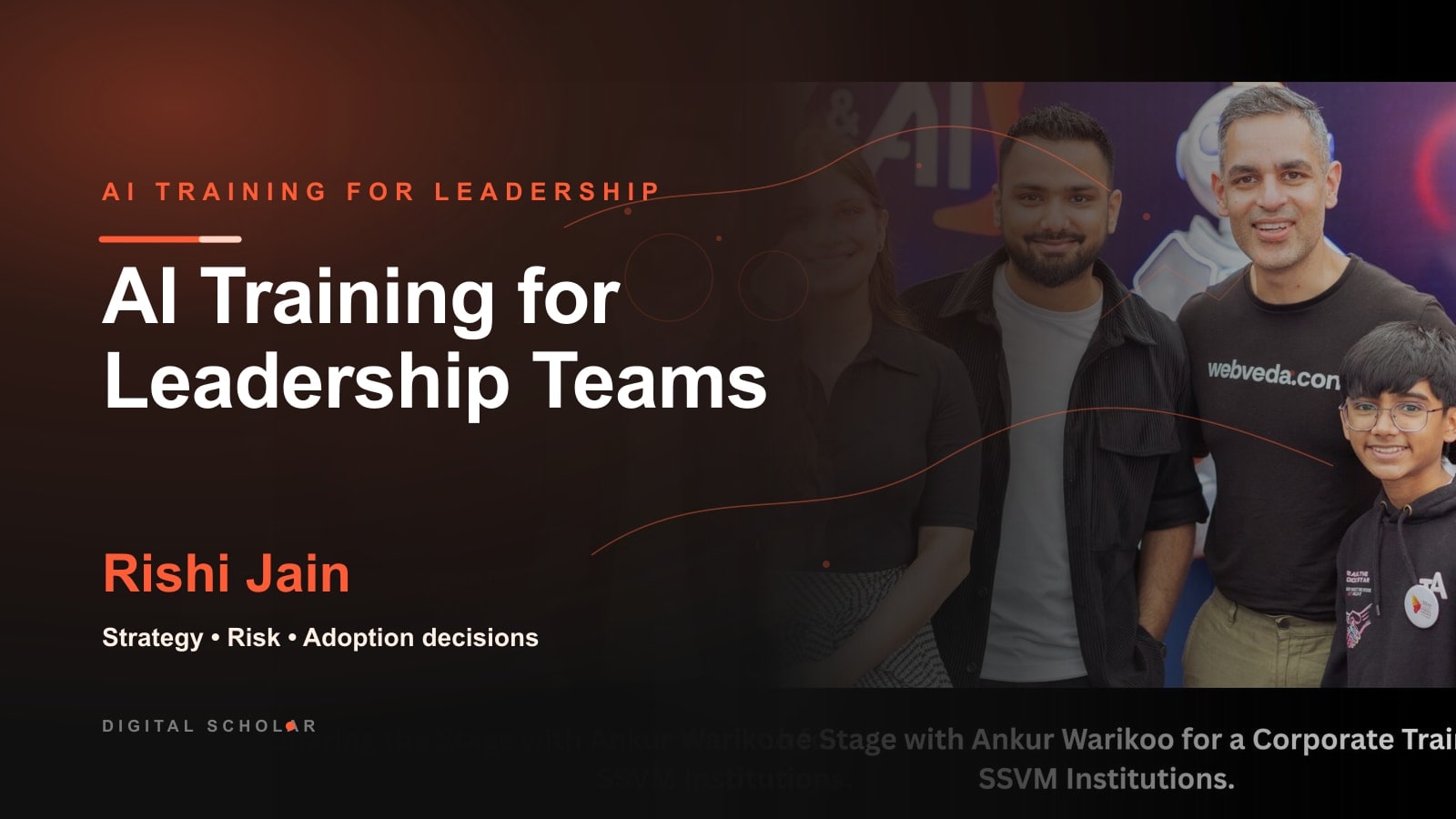
AI training for leadership teams should not be another briefing about how AI is changing everything. CXOs already know AI is changing everything. They have read the McKinsey decks, attended the BCG dinners, and seen the CEO LinkedIn post. They do not need persuasion. They need decisions.
The leadership briefings we run are designed to end with a small number of clear decisions. Not "we will explore AI". Decisions like: which 3 functions get AI training first, which tools are approved for company-wide use, who owns the AI roadmap, and what budget sits behind the next 12 months. If the briefing does not produce decisions, it was a presentation, not a session.
What CXOs actually need from AI training
- A clear map of what AI can do today, with calibration on what is hype
- The 5 to 7 places in your business where AI moves a needle worth caring about
- Risk, data, and compliance basics in plain English
- Budget thinking with realistic ROI ranges, not vendor numbers
- Build versus buy framework for each candidate use case
- A 90-day rollout pattern that does not require new headcount
- Governance, review, and audit checkpoints
- How to communicate the AI roadmap to the board and to employees
The three questions every leadership team has to answer
One: where does AI sit in our operating model? Is it a function (a team that does AI things)? Is it a tool (every function uses AI)? Is it both? Most Indian companies in 2026 are landing on "both, with a small centre of excellence and broad operator enablement". The leadership briefing helps the team land where they should land.
Two: who is the owner? AI without an owner stalls. The owner is not always the CTO. In 6 of the 11 leadership engagements we ran in 2026, the owner ended up being the COO. In 3, it was the CHRO. In 2, it was a newly created head of AI role. The owner has authority, budget access, and a quarterly review cadence with the CEO.
Three: what is the rollout sequence? Which function first, which second, and what is the gating criterion to move to the next. Most teams want to do everything at once. Doing everything at once is how nothing gets adopted. The briefing usually ends with a written 12-month sequence the team has agreed on.
The 5 functions where AI has the highest leverage for Indian companies
This list comes from the patterns we have seen across 100+ corporate engagements, not from a generic top-5 list. In rough order of leverage for Indian operating businesses in 2026:
Customer service and support. Reply drafting, ticket summarisation, escalation routing, and complaint pattern analysis. Highest immediate ROI in most cases.
Marketing and content. Brief writing, copy variants, content production at scale, and campaign analysis. Easy to measure, easy to roll out.
Sales and account research. Account briefs, follow-up drafts, proposal first drafts. Moves pipeline metrics in 30 to 60 days.
HR and recruiting. JD drafting, interview prep, onboarding plans, learning content. Reduces administrative load without changing the people-facing parts.
Finance and operations analysis. Reporting commentary, variance explanations, MIS summaries. The function with the most "obviously useful and obviously skipped" use cases.
What the leadership briefing avoids
Tool demos. Model comparisons. Pricing pages. Long technical explainers about how LLMs work. The CXOs in the room do not need this and frankly do not want it. The briefing is operating-model and decision-making focused. If the team wants the technical depth, the COO or CTO comes back for a separate 2-hour technical session, which we run on request but never bundle into the leadership briefing by default.
The risk and governance section
Every leadership briefing includes a 30-minute block on risk. The topics covered: data classification (what can go into a public tool, what cannot), vendor risk (what the enterprise contract should say), output review (where the human-in-the-loop is mandatory), employee policy (the simplest one-pager that covers 90% of cases), and audit (what the board will eventually ask).
For BFSI, healthcare, and pharma companies, this block expands to 45 to 60 minutes and includes regulatory context (RBI guidelines for BFSI, healthcare data norms, the DPDP framework). For other industries, 30 minutes is enough.
Honest admission
We have run leadership briefings that did not produce decisions. The CEO said "good session, let us discuss internally". The team did not discuss internally. Six months later, nothing had moved. The pattern we have learned: if the CEO does not explicitly say "by the end of this briefing we will have decided X, Y, Z", the briefing produces good notes and no movement.
So we now insist on the decision frame upfront. We ask the executive sponsor to name 3 to 5 decisions the room should land before they leave. The briefing is structured around those decisions. This shifts the conversation from "interesting" to "we have decided this and this is the next step".
Format and duration
The standard format is a 3 to 4 hour closed-door briefing. Half a day. The room is the CXO team plus optional invitees (head of AI if one exists, head of L&D, finance partner). We deliver on-site at your office or at a venue you pick.
The optional extension is a 1-day strategic session for the broader leadership group (function heads, senior directors), which we usually run 2 to 4 weeks after the CXO briefing. This is where the rollout sequence and function-specific plans get refined.
Cost and timing
A leadership briefing typically lands in the ₹2 lakh to ₹4 lakh band, plus travel for non-Chennai delivery. The 1-day strategic session is ₹3.5 lakh to ₹6 lakh. Multi-quarter advisory beyond the briefing is priced separately, typically as a retainer.
Discovery calls are free and usually happen within 48 hours of the enquiry. The custom briefing proposal lands within 48 hours after the call. Sessions run 2 to 4 weeks after booking, depending on calendar.
Booking
For a leadership-specific session, the fastest path is the corporate training enquiry form with "leadership briefing" in the message. For broader programme formats, see AI corporate training programmes. For an honest comparison against other Indian AI advisors and corporate trainers in this space, see Best AI corporate trainers in India 2026. For Rishi's keynote and conference work, see the speaking page.