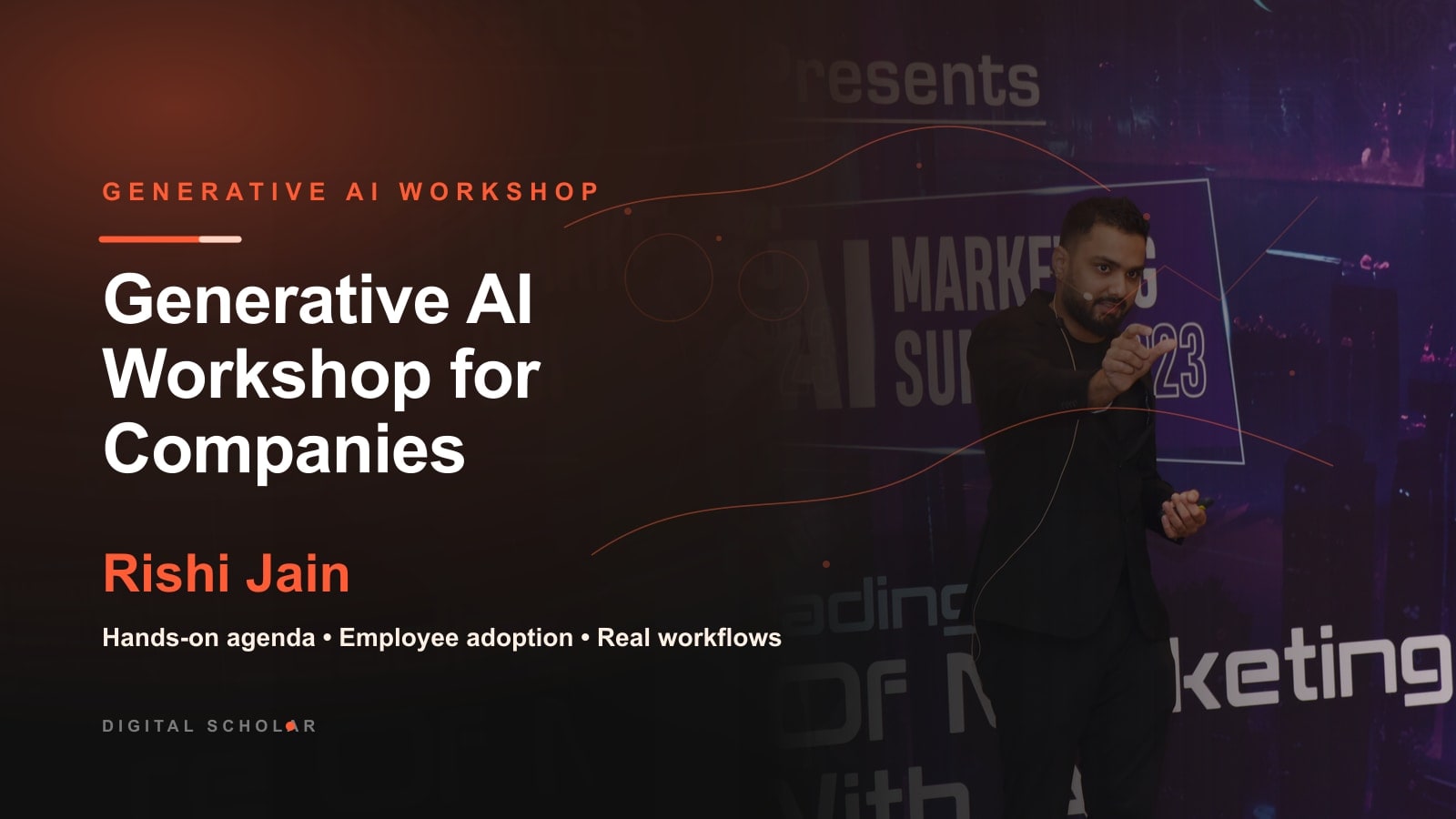
A generative AI workshop for companies should produce 4 things by the close of day: working workflows the team will use the next morning, a custom prompt library, an approved tools list, and a 30-day adoption plan. If a workshop ends with a thank-you slide and applause, it produced nothing.
This article walks through what a real generative AI workshop agenda looks like, what each session contains, what the team leaves with, and how the post-workshop period is structured so adoption actually happens.
The framing problem most workshops fail at
The single most common workshop mistake is framing the session as a "tools tour". The presenter walks through ChatGPT, Claude, Gemini, Perplexity, NotebookLM, Midjourney, ElevenLabs, HeyGen, and a few automation tools. Four hours later, the team is impressed and unable to remember what to do on Monday.
The right framing is "workflows that fit your team's actual work". The tools come up as they fit the workflows. The team leaves with patterns, not a list of demos. This is the difference between a workshop people enjoy and a workshop that produces behaviour change.
The ideal 1-day workshop agenda
Session 1 (90 min) · AI foundation and the CRAFT prompt pattern. What generative AI does well. Where it breaks. The 5-part CRAFT pattern (Context, Role, Action, Format, Tone). Hands-on rewriting of 6 to 8 bad prompts from the team's own work into clear briefings.
Session 2 (75 min) · Tool stack mapping. Not a demo of every tool. A working map of which tool fits which workflow. ChatGPT for general use. Claude (with Projects + Skills) for ongoing work. NotebookLM for research bundles. Perplexity for fast market context. Image and motion tools where they fit. The team picks the 4 to 6 tools they will actually adopt.
Session 3 (90 min) · Department workflow labs. Each function (marketing, sales, HR, operations, leadership) builds one real workflow with their own work as input. Marketing might build a campaign brief workflow. Sales might build an account research brief. HR might build an interview question bank. By the end, each function has a saved prompt template they will use the same week.
Session 4 (60 min) · Voice and brand consistency. The Brain Imprint method for capturing the company's voice in a reusable system prompt. Why generic AI output sounds wrong. How to set up a voice prompt that survives 60 days of use without drifting.
Session 5 (45 min) · AI policy, safe usage, and the verification habit. What never goes into a public tool. When the human-in-the-loop is mandatory. The simple 3-step output verification that takes 90 seconds and catches the 80% of errors that matter.
Session 6 (60 min) · Adoption plan. Each function writes their 30-day adoption plan with specific weekly milestones, check-in dates, and a designated "AI champion" who owns the function's progress. This is the session most workshops skip and the one that determines whether anything sticks.
What the team leaves with
- A 14 to 18-prompt library customised to the company and saved in a shared doc
- A team-specific approved tools list with rationale
- 3 to 5 deployed workflows tested with real company examples
- A working voice prompt (Brain Imprint output) for company communications
- A simple verification checklist for AI output review
- A function-level 30-day adoption plan with named owners and milestones
- An "AI policy summary" one-pager for distribution beyond the workshop
- 30 days of follow-up access via a private WhatsApp or Slack group
If any of these is missing from the workshop deliverables, the engagement is incomplete. We have seen workshops priced ₹4 lakh that delivered 2 of these 8. The team's behaviour did not change. The procurement team is now sceptical of all AI training. Avoid that situation by demanding the full deliverable list upfront.
The 2-day bootcamp upgrade
For teams that want more workflows shipped and more depth, the 2-day bootcamp adds a second day where each function ships 2 to 3 working AI workflows that integrate with their actual tools (CRM, project management, content systems).
The second day is heavy lab time. The trainer moves between teams. Each function builds, tests, and iterates. By the close of day two, the team has 5+ workflows live, not 2 or 3. The price difference (₹6 lakh to ₹12 lakh vs ₹3.5 lakh to ₹6 lakh) is justified for teams of 30+ where the per-person depth matters.
Multi-cohort programme for larger organisations
For companies with 100+ employees rolling out AI org-wide, the multi-cohort programme is the right format. The structure: a leadership briefing first, then one operator day per function (marketing, sales, HR, operations, customer service, finance, leadership), then 30 to 60 days of follow-up.
Each function's day is customised. The marketing day uses brand examples. The sales day uses real accounts. The HR day uses anonymised role descriptions. The finance day uses sample MIS data. This is the format that produces measurable org-wide adoption inside a quarter.
What good follow-up looks like
The post-workshop 30 days is what determines whether the engagement worked. Strong follow-up looks like: a private group for async Q&A, a scheduled check-in call at day 14 and day 30, a workflow review session where the team shows what they built, and a brief post-workshop survey at day 30 that measures actual adoption.
Weak follow-up looks like: a recap PDF emailed once and silence after. If the trainer offers only the second pattern, the workshop will likely not produce sustained behaviour change. The receipts back this up across the 100+ corporate engagements we have tracked.
Honest admission
Even with a well-designed workshop, 20 to 30% of attendees will not adopt the workflows. This is not a workshop failure. People have different roles, capacities, and motivations. The right success metric is not "100% adoption". It is "70 to 80% of the team running at least one AI workflow weekly at 60 days, with measurable time savings". A workshop that hits this is a strong engagement. A workshop chasing 100% adoption is chasing the wrong number.
Booking and scope
To start, request a discovery call via the corporate training enquiry form. The custom proposal lands within 48 hours. For format details, see AI corporate training programmes. For function-specific framings, see SaaS, FMCG, IT services, or any of the 8 industry pages. For comparison against other Indian trainers, see Best AI corporate trainers in India 2026.