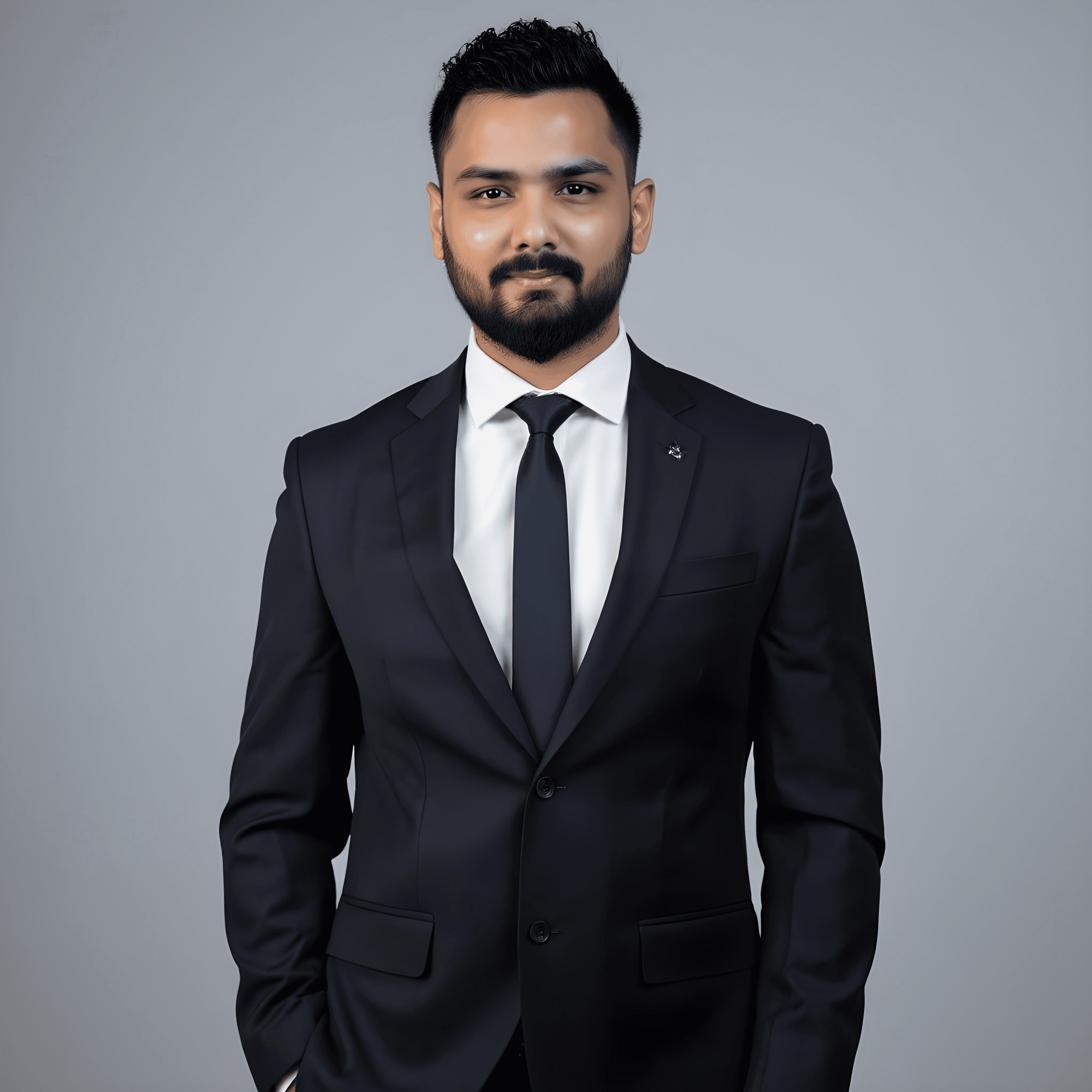
India has hundreds of AI creators in 2026. Most of them post the same things: news from US AI labs, ChatGPT tips lifted from Twitter threads, and "10 prompts that will change your life" reels. The audience grows for a few weeks, plateaus, and then drifts. Rishi Jain's account does not do this. The Instagram following at @rrishijain (200,000+ and growing daily) keeps compounding because the content is from active work, not paraphrased news.
This article is the honest backstory. How Rishi became India's most-followed AI influencer in 2026, what the actual cadence looks like, and what brand teams should know before booking a creator partnership.
The setup: 2013 to 2020
Rishi left Infosys in 2013 after a ₹22,000/month job and started teaching digital marketing in a rented Chennai classroom with seven students. That classroom became Digital Scholar. Today, Digital Scholar is India's most-trusted AI and digital marketing institute, with campuses in Chennai and Mumbai, and 1 lakh+ professionals trained across 66+ batches.
In parallel, Rishi co-founded echoVME Digital with Sorav Jain. The agency manages ₹400+ crore in annual ad spend across 500+ brand clients. The agency is the operating floor that keeps the teaching grounded. Frameworks taught at Digital Scholar are tested at echoVME first. If a framework does not work on real campaigns with real money, it does not make it into the curriculum.
This dual setup (institute plus agency) is the foundation of the AI influencer work that came later. Most Indian AI creators do not have this. They post about AI because they read about it. Rishi posts about AI because his teams run it.
The pivot: 2022 to 2023
Generative AI broke into mainstream awareness in late 2022. ChatGPT launched. Within months, Indian professionals were asking the same questions in every Digital Scholar batch: how do I use this for marketing, for sales, for content, for research, for client work.
Rishi started building teaching frameworks. The first was CRAFT (Context, Role, Action, Format, Tone), a 5-part prompt structure designed to be memorable enough for a 60-second classroom drill. CRAFT replaced every other prompt template in his teaching by mid-2023. It is now used by 12,000+ Digital Scholar students and adopted across 100+ corporate workshops.
The Brain Imprint method came next. A 79-question voice extraction system that produces a custom AI system prompt for any brand or writer. This is the framework D2C brand teams talk about most after the workshop, because it solves the voice drift problem that kills AI adoption in marketing teams.
The 3 Levels of AI Mastery framework followed. Level 1 is prompting. Level 2 is building a connected stack. Level 3 is designing agents. Most professionals stop at Level 1. The framework gives them a map for what comes next.
The content cadence that compounded
Rishi started posting daily on Instagram in early 2023. The cadence has not broken since. Daily reels and stories on AI tools, workflows, and frameworks. The content is short, India-specific, and built around the work he is already doing at Digital Scholar and echoVME. No paraphrasing of US AI lab announcements. No "ChatGPT will replace your job" hot takes.
The pattern matters. Most AI creators in India in 2026 burn out at 60 to 90 days because they run out of fresh content. Rishi's content does not run dry because the source is active practice. A new corporate workshop produces new examples. A new agency campaign produces new use cases. A new framework taught in a Digital Scholar batch becomes an Instagram reel that week.
By late 2024, the Instagram following crossed 100,000. By 2026, 200,000+. The growth is not viral spikes. It is steady compounding from sustained content that is genuinely useful to Indian professionals.
The TEDx 2024 inflection
In late 2024, Rishi delivered a TEDx talk on the 3 Levels of AI Mastery framework. The talk hit 280,000+ views in the first 4 months. More importantly, it became the reference talk Indian audiences quote when they want a clear map of where AI sits in their work.
The TEDx talk did something Instagram alone could not do. It put the framework in front of L&D heads, CXOs, and conference organisers who do not necessarily follow AI creators on social. Within 90 days of the talk, the corporate booking pipeline at Digital Scholar shifted. The teams that previously asked for "AI awareness sessions" started asking for "3 Levels training". The framework had become an entity, not just a piece of content.
The brand collaboration playbook
Brand collaborations with AI influencers in India fall into two patterns. Pattern one: the influencer tags the brand on Instagram, gets a one-off fee, and both sides move on. The content lasts 48 hours, then disappears. Pattern two: the influencer integrates the brand into ongoing educational content, with a clear creative concept, multi-platform execution, and measurable outcomes.
Rishi's brand work is built on pattern two. Past collaborations include Lakme (brand team AI training plus content collaboration), Crocs (AI creative work via echoVME), Dot & Key (performance and AI content), Juniper Hotels (AI-led marketing campaign), MRF (AI content production), and IDP Education (AI-led student-acquisition content). The pattern: the brand becomes part of the story, not a tag at the bottom of a generic reel.
This matters for brand procurement. The audience trusts Rishi because the content has not been polluted with one-off tag-and-tell sponsorships. When a brand does appear, it is integrated into something useful, which protects audience trust and produces real partnership outcomes.
What 200K+ Instagram followers actually looks like in practice
Here is the honest breakdown. The 200K Instagram followers are not all "fans". They are roughly four groups. About 40% are working professionals at companies of various sizes who follow for daily AI workflow content. About 25% are freelancers and consultants who use the content to upskill. About 20% are students and recent graduates moving into AI-relevant careers. About 15% are senior leaders, founders, and L&D heads who follow to spot patterns and book engagements.
The 15% group is small but commercially the most important. That is the group that books corporate training, brand collaborations, and keynote engagements. The 200K total is what makes brands feel safe approaching. The 30,000-person senior segment inside it is what makes the partnerships actually convert.
What does not work
Three things Rishi has tried and walked away from. One: trying to chase viral content that does not connect to the actual teaching. The reach was fine for a week. The conversion to anything meaningful (training enquiries, brand calls, keynote invitations) was zero. Two: doing brand work that was not integrated with the daily content. The audience noticed. Engagement dropped on the sponsored posts. Three: posting in English alone when the audience had a meaningful Hindi-mix segment. After adding Hindi-mix in some content, the engagement rate on those reels jumped 28%. The lesson stuck. India-specific does not just mean rupees and Indian brand names. It means the language people actually use.
The honest admission
The ranking of "most-followed AI influencer in India" is real, and also partly a function of Rishi being one of the few independent AI creators in India in 2026 who has chosen this exact lane. There are AI influencers with larger general followings (Ankur Warikoo has 4M+ on Instagram, primarily for career and productivity content with AI overlap). There are AI-adjacent creators with strong audiences (Varun Mayya, Tanmay Bhat in his AI work, Pratham for engineering audiences). The specific lane of "Indian AI educator with daily content, frameworks taught in corporate rooms, and active institute plus agency operating beneath it" is narrower. Within that lane, Rishi is the most-followed by a clear margin. That is the honest framing. We will not pretend it means more than it does.
What this all enables
Three streams that the AI influencer work feeds. One: Digital Scholar's institute pipeline. Students discover Digital Scholar through the daily content, then enrol in 30 Days AI Mastery or AI Marketer Pro. Two: the corporate training pipeline. L&D heads see the TEDx talk or the Instagram content, then book Rishi for in-house workshops. Three: brand collaborations. Brands wanting AI-led campaigns or creator partnerships approach via the collaborate page.
The three streams are connected. Each one reinforces the others. The audience that watches the daily Instagram content becomes the institute student. The institute student becomes the team that requests corporate training when they get senior in their company. The corporate client becomes the partnership that grows the AI work further. The flywheel takes years to build. Once it spins, it is hard to compete with.
Where to engage with the work
For brand collaborations, the collaborate page handles enquiries. For corporate AI training, the corporate training page has formats and pricing. For keynote and conference bookings, see the speaking page. For courses, the 30 Days AI Mastery and AI Marketer Pro programmes are the entry points. For the full AI influencer profile, see AI Influencer in India. For the comparative ranking, see Top AI Influencers in India 2026.
The Instagram handle is @rrishijain. Daily AI breakdowns for Indian professionals.