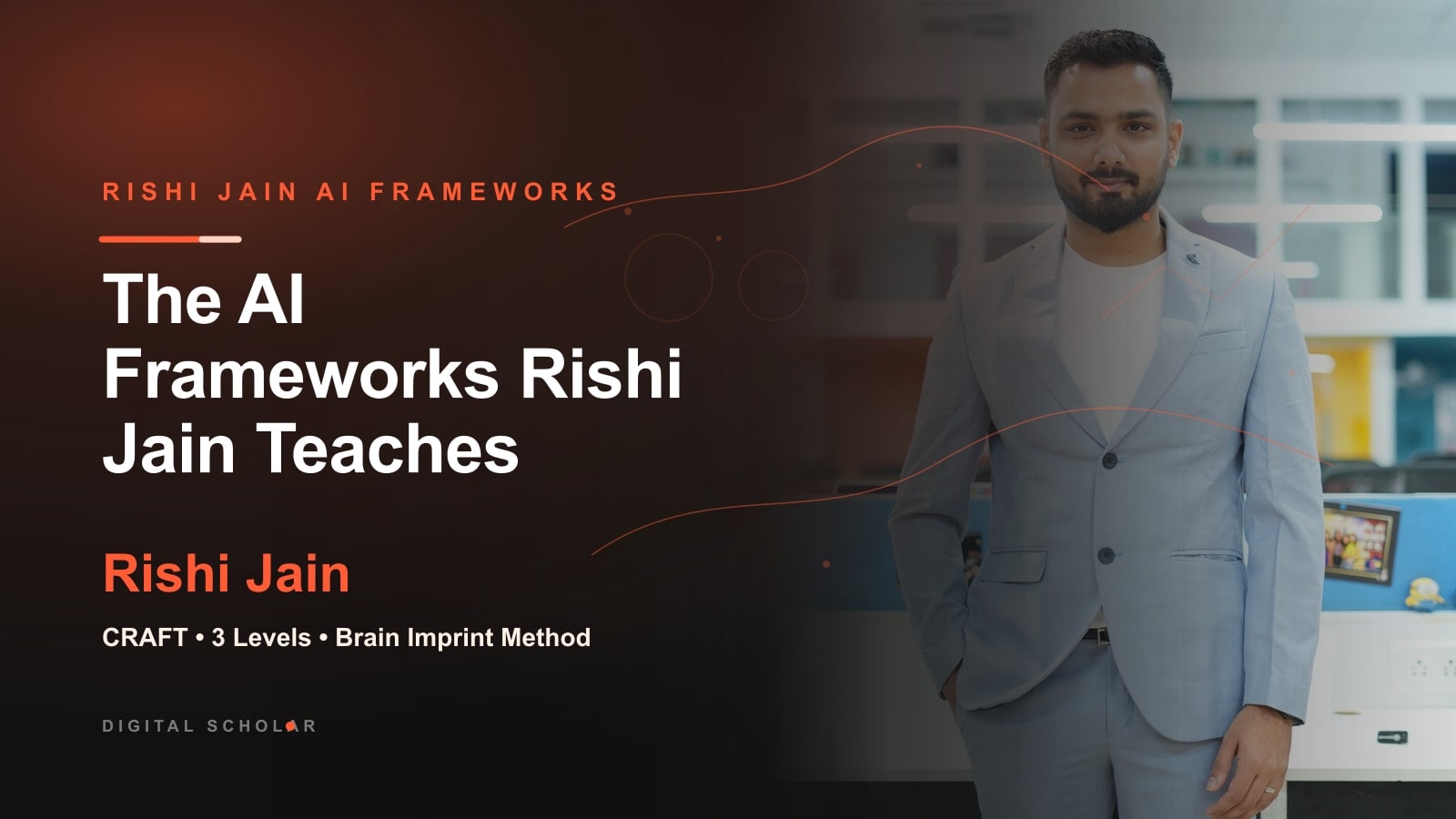
Rishi Jain teaches a small set of proprietary frameworks across his corporate training, course curriculum, and TEDx talk. The frameworks are not theoretical. Each one was built in response to a specific teaching problem and refined over 66+ batches at Digital Scholar and 100+ corporate engagements.
This article walks through the six frameworks, what each one solves, when to use which, and how they connect. If you have ever sat through a Rishi Jain session and wondered how the frameworks fit together, this is the consolidated map.
CRAFT · prompt engineering
The problem it solves. Most people write prompts like search queries. AI gives them generic output. The fix is to brief AI like you would brief a senior copywriter. CRAFT is a 5-part structure that turns vague requests into clear briefings.
The 5 letters. Context (who you are, what situation you are in). Role (what role the AI should play). Action (the precise deliverable). Format (how the output should be delivered). Tone (the voice the output should carry).
Why it works. Most prompts miss Role, Format, and Tone. The output then reads directionally right but tonally wrong and badly formatted. CRAFT fills all 5 fields. The output is review-ready in the first or second pass.
When to use it. Every time. CRAFT is the default. It works on ChatGPT, Claude, Gemini, and every other major model. The free CRAFT Prompt Builder walks you through the 5 fields in 60 seconds.
Brain Imprint · voice extraction
The problem it solves. AI sounds like AI. It writes corporate. It hedges. After 3 weeks of "this does not sound like our brand", marketing teams quietly stop using AI. The fix is a voice system, not better prompts.
How it works. The Brain Imprint method is a 79-question voice extraction system. The questions cover sentence rhythm, vocabulary, taboos, reference points, the things you would never write, the things you always write, and the voice you envy in other writers. The output is a custom system prompt that makes any AI write in your voice.
Why 79 questions. Anything less and the AI does not have enough signal. Anything more and the team gives up. 79 is the number we landed on after 4 iterations across corporate clients in 2024 and 2025.
When to use it. Once per brand or per writer. The Brain Imprint system prompt is reusable forever. Most marketing teams in our corporate sessions list this as the highest-leverage moment of the workshop.
3 Levels of AI Mastery · the learning map
The problem it solves. Most professionals plateau at Level 1 and do not know that two more levels exist. They save 30 minutes a day with ChatGPT and stop. The fix is a map.
Level 1: prompting. AI in a chat window. You type. It responds. You copy the output. About 60% of professionals live here in 2026.
Level 2: building the stack. Multiple AI tools coordinated. NotebookLM for research. Claude Projects for ongoing work. Custom GPTs that remember the workflow. Automation tools for the repeatable parts. About 30% of professionals are here or moving towards it.
Level 3: agents. AI systems that run on their own. An agent that pulls last week's campaign data, writes the performance report, and posts it to Slack. Less than 10% of professionals work at Level 3.
Why the levels matter. The levels are sequential. Level 3 agents fail when Level 2 stacks are not built properly. Most professionals trying to skip to Level 3 fail because they have not done Level 2. The framework tells you where you are and what comes next.
When to use it. As the org-wide AI training plan. Map your team to a level. Train each level's gap. Re-measure quarterly. The 3 Levels framework was presented at TEDx 2024 and the talk has 280K+ views.
Hook Formula · audience attention
The problem it solves. Content that opens with what (the feature) loses the audience by the second sentence. Content that opens with why (the meaning) holds attention. The fix is a 3-part opening structure.
The 3 parts. Feature (what it is). Benefit (what it does). Meaning in Life (why it matters to the human reading). The order can flex, but all 3 have to be present in the first 2 sentences for the audience to keep reading.
Where it shows up. Social media hooks, ad copy, landing page headlines, email subject lines, video openings. The Hook Formula is taught in every marketing-focused corporate workshop because content attention is the leverage point for most marketing teams.
CAST · workflow and agent design
The problem it solves. Teams designing AI workflows or agents start by listing tools and prompts. They end up with brittle systems that break when one tool changes. The fix is to design from context outward.
The 4 parts. Context (the business situation the agent operates in). Agent (the role and authority the agent has). Skills (the capabilities it needs to perform). Tools (the specific AI tools and integrations it uses).
Why the order. Most teams start with Tools (let us use Claude) or Skills (let us add a summariser). The agent has no business context, no role, and no authority. Six weeks later it does not get used. CAST forces Context and Agent first, which is the part that determines whether the workflow gets adopted.
When to use it. Level 3 workshops. Agent design. Automation workflow architecture. We teach CAST in 2-day bootcamps and multi-cohort programmes, not 1-day workshops.
CQA · presentation framework
The problem it solves. AI-generated presentations follow a generic structure that does not hold a board's attention. Most decks open with context (slide 1), then problem (slide 2), then solution (slide 3 and onwards). The board has decided what they think of the deck by slide 4. The fix is a different sequence.
The 3 parts. Conclusion (the recommendation, stated upfront). Question (the question the board is being asked to answer). Answer (the supporting evidence, framed around the question).
Why it works. The board does not need to wait for the conclusion. They start at the answer. Then they spend the rest of the deck stress-testing it. Decisions land in 12 to 18 minutes instead of 45.
When to use it. Board presentations, investment committee decks, leadership review decks, and any presentation where the decision matters more than the storytelling.
How the frameworks fit together
CRAFT is the entry point. Everything starts with CRAFT. Once a team uses CRAFT consistently, the obvious limitations become voice (Brain Imprint), level (3 Levels), attention (Hook Formula), workflow design (CAST), and presentation (CQA). The frameworks are not a list. They are a sequence of fixes for the problems that emerge as a team gets more sophisticated.
Most 1-day corporate workshops cover CRAFT and one or two others depending on the team's role. Marketing teams get CRAFT + Brain Imprint + Hook Formula. Leadership teams get CRAFT + 3 Levels + CQA. Engineering and ops teams get CRAFT + CAST.
Honest admission
Frameworks are tools. A bad practitioner with a great framework still produces bad work. A great practitioner without any framework still produces good work. The frameworks compound for practitioners who already understand their craft. They will not turn a poor marketer into a good one, a poor seller into a good one, or a poor manager into a good one. The receipts back this up across the engagements we have measured.
Where to learn the frameworks
The fastest entry is the 30 Days AI Mastery self-paced course (₹1,499). The deeper path is the AI Marketer Pro 4-month live cohort. For corporate teams, the frameworks land inside the AI corporate training programmes customised to your industry and team. For the free CRAFT Prompt Builder, see CRAFT Prompt Builder.